2021 Beaver Works Summer Institute (BWSI)

Greetings, Magnetos! The MIT (Yes, that MIT) Beaver Works Summer Institute (BWSI) is a rigorous, world-class STEM program for motivated high school student . This four-week virtual program teaches STEM skills through project-based, workshop-style courses.

The Beaver Works Summer Institute is pleased to announce that they will have 13 virtual program offerings for summer 2021.  To begin the process of pre-qualifying to apply for the summer institute, students will work through a series of pre-requisite self-paced units.  Participation and performance in the online curriculum during the winter (starting in late January or early February) will be one of the metrics used to determine acceptance into the 4-week program being held in July 2021, which will be taught over the summer at a higher level and will address more research-oriented technologies, techniques, tools, and applications.

We’ve had quite a few Magnetos and other CHS students over the last few years take advantage of the MIT BWSI, which is a pretty remarkable experience from what I can gather.  Spend a month over the summer working with MIT professors and motivated students from all over the U.S. doing super cool science stuff?  Sounds like a winner to me.  Anyone interested? If so and you’re serious about doing the pre-req mods over the winter and applying to BWSI for the summer, I’d be happy to recommend you, which is what they’ve asked me to do (be the point of contact for you and this program …).  So if that’s you, send Mr. Greene an email to let him know you’re interested.

Short PamphletLong Pamphlet

Requirements/Info:

  • They are rising seniors attending high school in US or US citizen abroad
  • They have demonstrated technical ability (evidenced by recommendations from school officials, test scores, coursework, grades, and extracurricular activities)
  • They have completed the lessons in the online tutorial for their desired project
  • Online course starts February 2021 (prerequisite in order to apply to the July program)
  • Virtual BWSI runs July 5 – August 1 2021
  • To get more information: https://beaverworks.ll.mit.edu/CMS/bw/BWSI

Permanent link to this article: https://chsmstmagnet.com/2020/12/2021-beaver-works-summer-institute-bwsi/

MST Senior Internship Showcase

Since our MST Seniors are unable to present to you in person due to the current COVID-19 restrictions in place for our community, we have instead asked each one of them to produce a short video discussing their research and what they learned through their culminating internship projects.

Please take a moment to peruse the interest based playlists below to see and hear what you have made possible through your continued support of the Math, Science, and Technology Magnet program at CHS.

Congratulations, Seniors!

Permanent link to this article: https://chsmstmagnet.com/2020/12/mst-senior-internship-showcase/

Clark County Food Bank Service Night

This past Tuesday would’ve been one of our MST group’s annual “nights of service” where we would have gone as a group (staff, students, and families …) to the  Clark County Food Bank and help repack donated food for distribution to local families.  Sadly, we were unable to keep this appointment due to Covid restrictions, but the need for help in our community is still there. In lieu of the time you would’ve donated, consider visiting their site and learning about their programs and how to support our county’s most vulnerable citizens. There are people hurting out there.  Clark County Food Bank

Permanent link to this article: https://chsmstmagnet.com/2020/10/clark-county-food-bank-service-night/

Young Women in Bio Web Panel 10/7/20

This cool opportunity for a free, virtual web panel just in (from CHS/MST grad Sophie Shoemaker, class of 2015). The event is scheduled for Wednesday, October 7, 2020, 4:00 p.m. – 5:30 p.m. PDT

Considering pursuing a STEM major in college? Join us for a panel of renowned research scientists who will talk about their diverse trajectories to science and what they’re doing now: Dr. Rochelle Buffenstein, Dr. Amoolya Singh, Dr. Magdalena Lopez, and Dr. Ellie Karlsson.

Registration is open through tomorrow via this link: https://www.womeninbio.org/event/SFYWIB10720 

Permanent link to this article: https://chsmstmagnet.com/2020/10/young-women-in-bio-web-panel-10-7-20/

NCSSS Virtual College Fair

As a member of the National Consortium of Secondary STEM Schools, Camas High School and the  CHS MST Magnet program are pleased to invite our students and their parents to the first NCSSS Virtual College Fair 4:30 – 6:30 p.m. ET Tuesday, October 20, 2020.

Invited NCSSS Member colleges include, but are not limited to:

• Illinois Institute of Technology
• Olin College of Engineering
• Case Western Reserve University
• Columbia University
• Kansas State University
• Massachusetts Institute of Technology
• Northwestern University
• Randolph College
• Rensselaer Polytechnic Institute
• Southern Illinois University – Edwardsville
• St. Louis College of Pharmacy
• Smith College
• Syracuse University
• University of Miami

Students who visit at least four colleges and collect a code word from each school will be entered into a raffle for a $50 Amazon gift card.

Please register HERE by Friday, October 16.

Any questions may be directed to NCSSS Membership Director, Beth Hartgen.

Here’s the flyer: NCSSS Virtual College Fair

Permanent link to this article: https://chsmstmagnet.com/2020/09/ncsss-virtual-college-fair/

MIT Beaverworks Fall Zoom Institutes for Girls

Our friends at MIT (yes, that MIT …) are hosting a series of Saturday institutes for girls interested in learning about robotics, cyber security, and programming. Check it out:

Who/What: High school female students in grades 9-11 interested in learning about 1 of 3 opportunities (see the PDFs  below for details on each)! Beginners encouraged! No coding experience needed. FYI: You can only participate in one of the choices. 
When: Saturdays 11am-2pm (EST) – 10/17, 10/24, 10/31, 11/7, 11/14, 11/21, 12/5, 12/12 or 12/19 (last two dates depend on your choice of institute).
Where: Virtually, through Zoom!

Access the registration info through the PDFs below OR on their website: Beaver Works Summer Institute (BWSI) High School Fall Program for Girls

Permanent link to this article: https://chsmstmagnet.com/2020/09/mit-beaverworks-fall-zoom-institutes-for-girls/

Caltech STEMchats Speaker Series

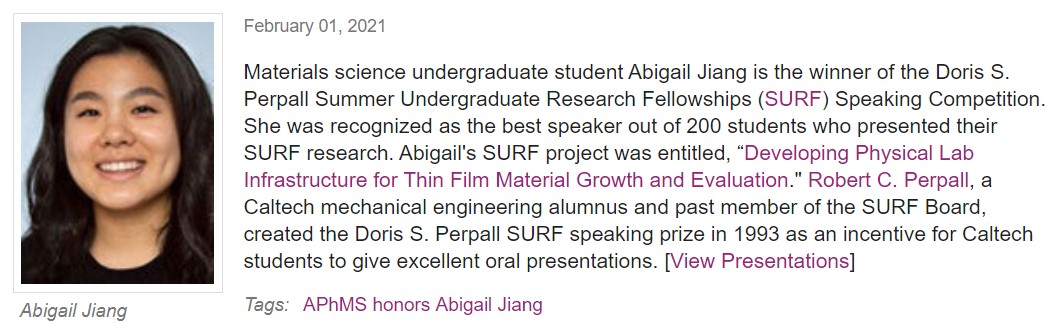
2019 CHS/MST grad Abigail Jiang, currently studying at Caltech, reached out to us with this exciting opportunity. Registration required. Check it out:

If you’re interested in learning about STEM research, physics, international journeys in science, or want the opportunity to connect with a professor from a top STEM school in the country, please join us! On Friday, Sept 25th, from 5-6:30 pm PDT/8-9:30 pm EDTProfessor Joseph Falson of Caltech will be discussing “What is fundamental research and how is it important?” on Zoom. RSVP & more details here: http://bit.ly/stemchats-ss

Joseph Falson is a Professor of Materials Science at Caltech. In this Speaker Series seminar, Prof. Falson will discuss the importance of fundamental scientific research, and how it differs from applied sciences and research. He will also chat about his research in materials science and physics, as well as his international journey in STEM and higher education from Australia, to Japan, to Germany, and finally to the US. There will be an interactive live Q&A where attendees can ask Prof. Falson questions, and this event is open to students from any background!

This event is hosted by STEMchats Speaker Series. Learn more and RSVP here: http://bit.ly/stemchats-ss

Permanent link to this article: https://chsmstmagnet.com/2020/09/caltech-stemchats-speaker-series/

2020 MST Digital Research Symposium

In light of the ongoing disruption that Coronavirus poses to our lives, which includes the cancellation of what would have been our 13th annual MST Research Symposium, we are making available a playlist of selected video presentations of a few senior, sophomore, and freshmen projects (juniors don’t complete formal projects as they prepare for their internships …). We are also including in this description a link to a Drive folder that has ALL of our project study done this year. Great work, Magnetos! Please take a moment to peruse the bounty of their work: 2020 MST Digital Research Symposium

Permanent link to this article: https://chsmstmagnet.com/2020/06/2020-mst-digital-research-symposium/

Research Spotlight: Concrete Fungus Repair

In light of the ongoing disruption that Coronavirus poses to our lives, which includes the cancellation of our annual MST Research Symposium, we are publishing a series of posts on MST students and their research that have been peer selected for excellence.

We asked each group selected to give us info on their abstract, the biggest takeaway from their project study, and something they are excited about for the upcoming year, as well as a few photos.  This post covers work done by MST sophomores Pauline Do, Natalie Ge, and Nels Martin.

ABSTRACT: Currently, societies everywhere are refilling fractures in cement for sidewalks, buildings, and other structures by hand, which can be a dangerous and costly job. During cement production, CO₂ is released when calcium carbonate is thermally decomposed, which contributes to the greenhouse effect. Trichoderma reesei (T. reesei) is a fungus with the ability to secrete calcium carbonate (CaCO₃) as a product of its metabolic processes. T. reesei can be incorporated into cement to heal structural damage by lying dormant until its incubating cement is damaged. As the fungus is exposed to moisture and oxygen from the external environment, it will germinate and produce CaCO₃ to repair the fracture and then form spores again once the crack has been sealed. The purpose of this experiment is to gather more information on the efficiency of this procedure by incorporating different amounts of T. reesei into cement. This experiment found that cement infused with 4 mL of a T. reesei nutrient broth solution was able to begin healing itself within the time allotted for our experiment.  Read about their findings here: The Healing Capabilities of Trichoderma Reesei in Concrete.

When asked about their biggest takeaways from their project study this year, they said,  “Our biggest takeaway from this year’s project study was that experiments or projects may experience unexpected setbacks, and although things may not go entirely as planned or events out of your hands may fall though, it is important to persevere and continue to the best of your abilities. For example, the fungus we needed to conduct our experiment was delayed from arriving for several months, so we definitely had to make some adaptations to our plan to accommodate this change.”

As for next year, they said, “We are excited to start our internships. We are hoping to gain more hands-on experience in fields that we are interested in. The process of looking for internships may be difficult at first but all of us are very excited to see how real labs work. We are excited to learn from researchers who have much more experience and knowledge than we do and try to apply our knowledge in our future careers and further education.”

Permanent link to this article: https://chsmstmagnet.com/2020/06/research-spotlight-concrete-fungus-repair/

Research Spotlight: Music Transcription with A.I.

In light of the ongoing disruption that Coronavirus poses to our lives, which includes the cancellation of our annual MST Research Symposium, we are publishing a series of posts on MST students and their research that have been peer selected for excellence.

We asked each group selected to give us info on their abstract, the biggest takeaway from their project study, and something they are excited about for the upcoming year, as well as a few photos.  This post covers the work done by MST sophomores Ashton Doane, Chris Spencer, and Sunny Wang.

Abstract: Sophomores Ashton Doane, Chris Spencer, and Sunny Wang conducted research on the applicability of neural networks to music transcription. Music transcription is the task of taking some audio and creating sheet music, a notation of how to play it on an instrument. The overall goal of the project was, “to achieve great accuracy in transcribing polyphonic music through machine learning, hopefully having a higher maximum potential for transcription than humans.” Using some key insights into the inner workings of musical structure, they created multiple models to attempt to increase accuracy. Their results can be found here: Automating Music Transcription with Artificial Intelligence.

When asked about their biggest takeaways from their project study this year, they said it “…  was that a lot of preparation work must be done to effectively finish a task, yet there still needs to be room for adjustment when things go off course. Making sure that you can make a plan and stick to it without cheating or taking days off makes sure that you can finish a project.”

As for next year, they said, “Internships are approaching, which is very exciting, as they give an opportunity to work in a real scientific environment. The real excitement here is in getting new ideas and seeing if a certain job is a good fit for people. The opportunity to both try out a job and meet new people is a great advancement in life.”

Permanent link to this article: https://chsmstmagnet.com/2020/06/research-spotlight-music-transcription-with-a-i/